Bereshis and Brotherly love / בראשית
Dysfunctional siblings and intergenerational trauma


This is a weekly series
of parsha dvarim (Tōrah commentaries) written by an orthodox atheist transsexual anarchist, with guest posts from comrades. It's the work of each generation to extricate meaning from our cultural and religious inheritance, and it's crucial that we resist the narrative that Zionism owns Judaism. We aim to offer comment which is true to the pshat (i.e. engages with the plain meaning of the text) especially when it's difficult, and uses Tōrah like a light to reflect on our modern times.
Content note
Childhood sexual abuse (CSA)
For anyone who needs support: You can always call, text, or Signal message the 24/7 RAINN hotline. I've found them to be competent. It's a national hotline in America but (if you use Signal) they don't need to know what country you're in.
Enmity l'dor v'dor
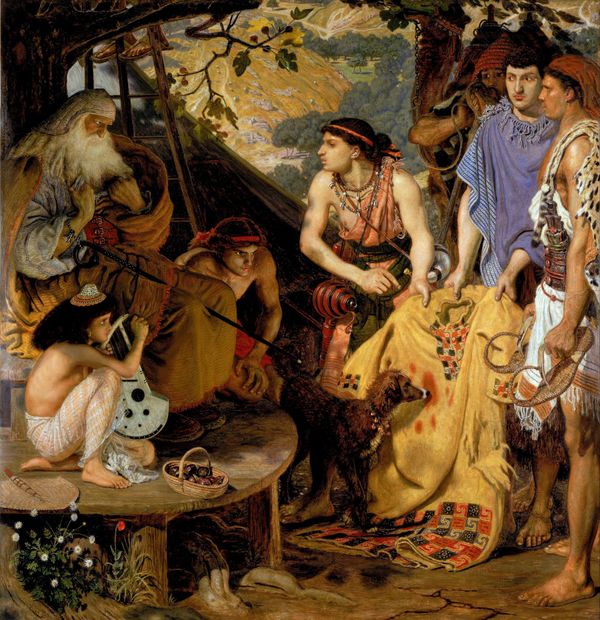
It's the first parsha again. Kain kills his brother Hevel (הבל, "breath", often called Abel).
Kain is the first murderer. He's also the firstborn person: the first person to be morally guided not by Hashem but by his parents. What do they teach him? Just as all our heroes stand on the shoulders of giants, so too our sinners. Our trauma is intergenerational and we will never truly understand it.
After Odom and Khava eat from the Tree of Knowledge, Hashem curses them:
Bereshis 3:15
Much is made by how the Israelites, their ancestors and their offspring fail Hashem, starting with the very first human beings. We the people are a perpetual disappointment. Kain is surely a disappointment to his parents. He failed them and he failed G-d. Did they fail him too? To what extent, if any, are Odom, Khava, and Hashem responsible for Kain's grave sin against Hevel?
Torah poetically mirrors the sin of Odom and Khava with the sin of Kain. For Odom, "Cursed be the ground because of you," (3:17). For Kain, "You shall be more cursed than the ground," (4:11). Both Odom and Kain are sent "East" from Gan-Eyden, away from Hashem's presence. Responsibility is tricky to litigate. The parents and child are not the same, but their sins and curses echo each other.
One must imagine that Odom and Khava are devastated by the death of their son Hevel. Torah doesn't give a post-murder description of the family, but we have the earlier curse: the children shall strike at the parents' heads, and the parents shall strike at their children's heels. It seems children are doomed to repeat their parents' mistakes, and we are all doomed to hate each other for it.
"Am I my brother's keeper?"
Bereshis 4:8–9
I'm not my brother's keeper. My brother and I haven't spoken in quite a long time. Three years apart in age, I bullied him when we were young children, until my step-father arrived to bully us both. Kain's lie—"I don't know"—is intimately familiar to me, to my shame. I'm 10 years old. I've done something wrong and I don't want to get in trouble. I'm not very sophisticated. In Torah, Kain doesn't fool anyone. In my life, my childhood lies were enough to placate my mother, who trusted me despite the tears staining my younger brother's cheeks. He was more often punished for my transgressions than I was.
My step-father brought two sons with him, both slightly older than me. It was my turn to be victimized. One of them molested me. I didn't tell anyone for decades. I was 9 and I froze, holding my breath. I'm not sure if I've ever breathed easy since.
My little family drama is nothing remarkable, a microcosm for cruelty and maybe a helpful aid to reading this text. If I can contextualize my trauma in Torah, then I can understand it. If I can intellectualize my trauma, then it isn't as painful emotionally.
This is the end of the public preview. Sign up for $5 a month to read the full dvar and support trans antizionist Tōrah scholarship.
Money shouldn't a barrier to accessing writing, art, and culture. If $5 a month isn't sustainable for you, please email me and I'll send you the link to sign up for free.